Gold, Silver, Bitcoin Sell-Off: Hawkish Fed Impact
A hawkish Federal Reserve and stronger dollar are unwinding the 'debasement trade', hitting gold, silver, and Bitcoin simultaneously.
•TradeRadarNews Australia Editorial
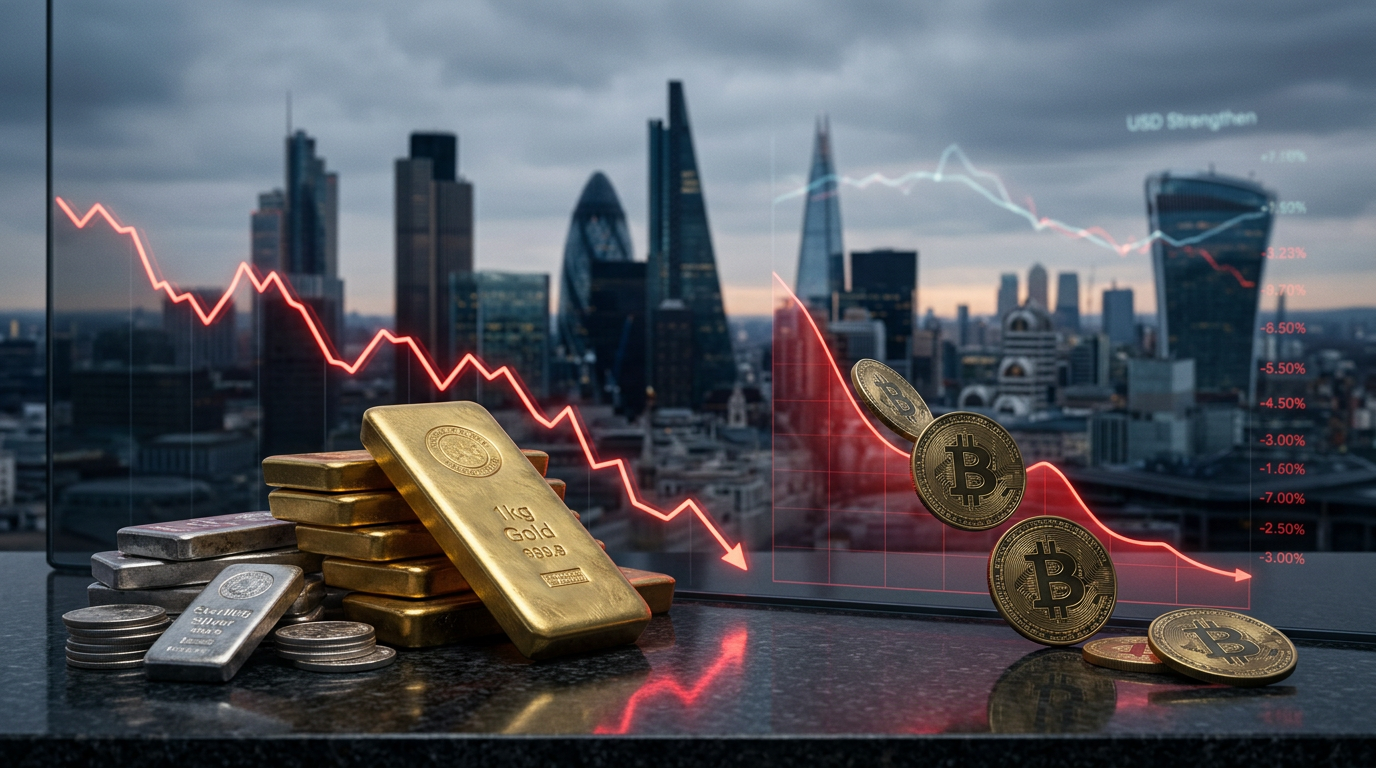
A significant market shift is currently impacting gold, silver, and Bitcoin, as investors withdraw from assets previously regarded as safeguards against currency devaluation. This broad 'debasement trade' unwinding is largely attributed to a more aggressive Federal Reserve, led by Chair Kevin Warsh, and a strengthening US dollar.
Historically, Bitcoin has been associated with precious metals as a hedge against a depreciating dollar. However, this established pattern is now reversing. The Federal Reserve's hawkish stance and the resulting stronger dollar are increasing real yields, making non-yielding assets such as gold, silver, and Bitcoin less attractive. Furthermore, a stronger dollar makes these assets more expensive for international buyers.
Bitcoin, despite initially lagging behind metals during their ascent, is now closely mirroring their decline. It has shed approximately 50% from its peak, even while recently outperforming gold and silver on a relative basis. This highlights Bitcoin's dual nature: it acts as both a speculative investment and a hard-money hedge.
The current enthusiasm for artificial intelligence (AI) stocks is also redirecting capital across the market. Funds are being pulled from traditional precious metals, which are typically considered safe-haven assets, as well as from the cryptocurrency market, often seen as higher risk.
Earlier this week, gold dipped below £3,150 for the first time since November (approximately $4,000 using a 1 USD = 0.79 GBP exchange rate for context, though the article provides the USD figure). Silver has lost over half its peak value, and Bitcoin has fallen to nearly £45,600 (approximately $58,000). These simultaneous declines are not coincidental.
For the past two years, these three assets have largely been part of the same investment strategy, termed the 'debasement trade.' This strategy is based on the premise that extensive government spending and increasing national debt will gradually erode the value of fiat currencies. Consequently, investors seek refuge in scarce assets that cannot be arbitrarily created by governments. Gold and silver represent the traditional form of this bet, while Bitcoin, with its finite supply of 21 million coins, emerged as the digital equivalent.
Throughout 2025, as the dollar appeared vulnerable, substantial capital flowed into all three assets, effectively treating them as a unified basket. The forces that grouped them together during their rise are now responsible for their collective decline.
Federal Reserve Chair Kevin Warsh adopted a hawkish tone at his inaugural meeting, leading markets to anticipate two quarter-point rate increases by March 2027. These hikes would push the Fed's benchmark rate to between 4.00% and 4.25%. The US dollar has already gained 0.8% this week alone. Both higher interest rates and a stronger dollar directly oppose hard assets, as higher real yields from safe assets like Treasuries increase the opportunity cost of holding non-yielding assets such as gold, silver, or Bitcoin.